

Thinking in Extremes: All-or-Nothing Thinking and Overgeneralisation
How Thinking in Extremes Narrows Experience

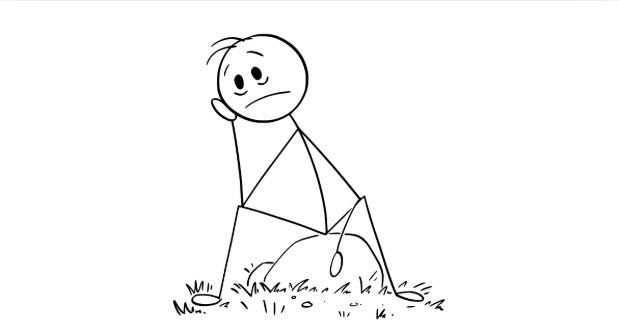
This month, I’ll be writing about familiar patterns of thinking first described by Aaron T. Beck.
Beck noticed that when people are distressed, their thinking tends to follow familiar patterns, ways of interpreting experience that appear again and again when the mind is under pressure.
He called these patterns cognitive distortions.
The term can sound technical, but the idea itself is simple!
When the mind is under pressure, it relies on shortcuts. These shortcuts bring a sense of control and certainty, and in doing so they influence how we see ourselves, other people, and what we expect from the world.
Beck’s contribution was to notice these shortcuts as habits of interpretation. And you see, once seen as habits, they become easier to identify, and easier to be seen lightly rather than taken as facts.
So, over February, I’ll explore a few of these habits. One/two at a time. Discussing how they emerge in ordinary moments of everyday life.
Today, I’ll begin with a way of thinking that feels familiar to most of us, especially when things feel difficult.
When one thing becomes everything
Most of us know this moment: Something goes wrong, perhaps nothing major, but just enough to leave an aftertaste. And instead of staying contained within that moment, the mind allows it to generalise.
This is what minds tend to do!
A single awkward exchange becomes a statement about how conversations always go.
That’s where the pattern begins.
How distress narrows perception
It’s like a cup filled just past the brim, where the overflow starts to speak for the contents.
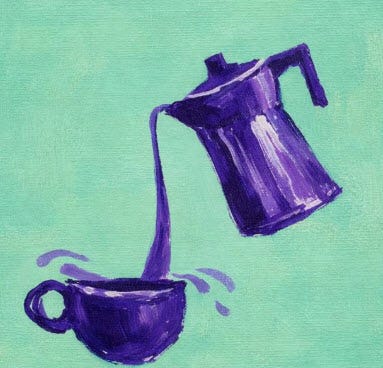
When experience becomes harder to manage, the mind works with a narrower range. It becomes less tolerant of complexity and less able to hold competing understandings at once.
What might otherwise stay open for evaluation is pushed toward a conclusion.
In that narrowing, extremes begin to serve a function: A single conclusion replaces a field of possibilities. The result feels simpler to live with, even though it loses proportion.
Identifying the pattern
Aaron T. Beck first described this way of thinking in a 1963 paper on depression [1].
In cognitive therapy, it’s described as all-or-nothing thinking, and as overgeneralisation. These terms describe what happens when a single experience is allowed to set the terms for everything that has passed and, sometimes, that follows (i.e. it’ll forever be like this!).
You can hear it in the conclusions that appear almost automatically.
“This always happens.”
“That’s just the kind of person I am.”
Once phrased this way, the experience no longer stays specific to a moment or particular experience, It has been turned into a rule.
The cost of thinking in extremes
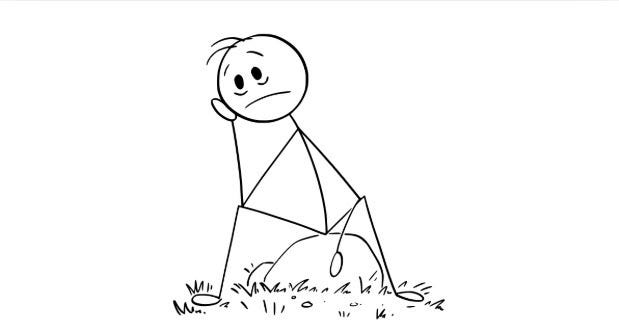
When all-or-nothing thinking and overgeneralisation take hold, experience starts to be handled in bulk. Differences and nuance are overlooked, context fades, and new situations are met with conclusions already in place.
Over time, this changes how life is encountered.
Situations are no longer approached on their own terms, but treated as further examples of something already decided. The present is read through past conclusions, and alternatives that do not fit are quickly set aside.
The cost appears as psychological rigidity.
Fewer responses feel available, reactivity becomes more likely, and outcomes start to feel predictable, because perception and interpretation have been narrowed in advance.
Where, in my own thinking, do I first notice this is happening?
These cognitive distortions tend to emerge when a thought stops staying close to what just occurred and begins to speak more broadly.
The early signal is a change away from the particular toward the general. What begins as a response to one situation is reformulated as a statement about life, the world, or identity.
Another common signal is the arrival of totalising language: words such as always, never, everyone, nothing appear as if they naturally belong. The thought sounds finished, as though no further information is required: “It’s always been this way”, “You never get it.”
This is typically the point at which all-or-nothing thinking and overgeneralisation settle in, through language in thought or in speech that feels neat, decisive, and sufficient.
Low Mood & Anxious States
What this rigidity costs us is not only nuance, but flexibility of mind.
When experience is repeatedly filtered through global or extreme conclusions, situations begin to feel predictable in advance. Outcomes are anticipated before they occur, and interpretation becomes increasingly narrow. This is the mechanism I described earlier.
The present situation is no longer seen for what it is.
Over time, this way of thinking does more than limit perspective. It not only fosters but also maintains states of anxiety and low mood.
Anxious states are reinforced when thinking repeatedly projects broad negative expectations forward: “It will never work out.” Depressed mood is sustained when past conclusions continue to define the present: “Nothing has gone my way.” In both cases, it is the persistence of these cognitive rules, long after the original event, that perpetuates distress.

A more flexible way of thinking works against this escalation by keeping interpretations closer to the situations that give rise to them. When conclusions remain proportionate, experience retains more range, and mood is less governed by biased interpretation.
Conclusion
Cognitive distortions are often discussed as errors in thinking. Beck’s original contribution was to show that these errors are not incidental, but habitual. They reflect consistent ways of interpreting experience that emerge when the mind is under pressure.
All-or-nothing thinking and overgeneralisation follow this same logic. They offer confidence by reducing complexity, and decisiveness by collapsing range. In doing so, they make experience easier to organise, but harder to engage with on its own terms.
Once these habits are identified at the point where they form, they no longer function as default conclusions.
That does not remove the shortcut, but It changes its standing.
And in that change, thinking regains some of the flexibility that certainty trades away: a wider range of interpretations, fewer conclusions drawn in advance, and more room for experience to register before it is decided.
Reference List:
Beck, A. T. (1963). Thinking and depression: I. Idiosyncratic content and cognitive distortions. Archives of General Psychiatry, 9(4), 324–333. https://doi.org/10.1001/archpsyc.1963.01720160014002
Seems to be a first-day-of-therapy lesson! So hard to get rid of old habits. It’s easier to believe: “Everyone hates me!” 😂😂😂
Cognitive distortions. Hm. That implies a sense of “incorrectness.”
“Incorrectedness?” “Not Correct, Ed Ness?”
Either way, it makes me feel like typing, which I have not done in some time.
I understand the premise, and I often find myself irritated by others doing exactly this, usually without realizing it. Of course, I tend to see myself as largely above such behavior.
But what might be called a distortion feels less like an error and more like hyperfocusing on a single detail, a kind of intentional narrowing that allows me to remain unconcerned with the progression of, or possibilities within, whatever it is I’m supposedly “distorting.”
Whether that’s a flaw or a feature probably depends on the moment.
For me, it's more of a way to handle something large in smaller, manageable pieces so that my inner angermonkey doesn't claw it's way out and do something for which I will have to atone.
I suppose the difference is that I choose to narrow, and I think what you are saying is that when we do this without being aware of it, the problems come calling?